Diamond Batteries : Harnessing Nuclear Waste Through Advanced Materials Science
In the realm of materials science, few innovations bridge nuclear waste management and energy generation as elegantly as diamond batteries. These betavoltaic devices, pioneered by researchers at the University of Bristol and the UK Atomic Energy Authority (UKAEA), use synthetic diamond to convert the beta decay of radioactive carbon-14 (¹⁴C) into a steady trickle of electricity. Recent breakthroughs, including the world’s first ¹⁴C diamond battery announced in late 2024, highlight the unique properties of diamond as both a semiconductor and a radiation shield.
The Core Materials: Why Diamond?
Diamond stands out due to its exceptional properties: it is the hardest known natural material, possesses the highest thermal conductivity, and features a wide bandgap (~5.5 eV) that makes it an outstanding semiconductor for harsh environments. Unlike silicon, diamond is highly radiation-hard, resisting degradation from particle bombardment.
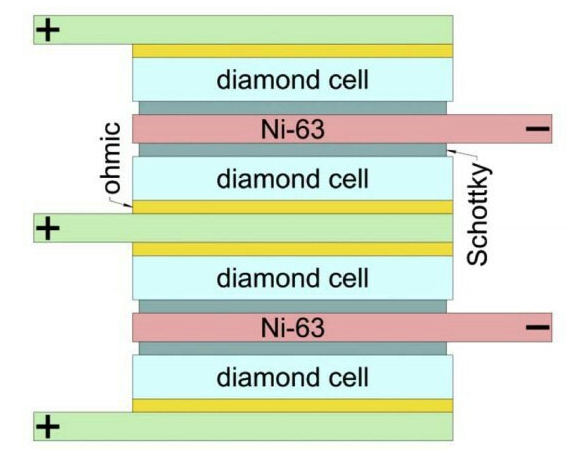
In these batteries, synthetic diamonds are grown via Chemical Vapor Deposition (CVD). Radioactive ¹⁴C, extracted from irradiated graphite moderator blocks in nuclear reactors, is incorporated into the diamond lattice. The process often uses ¹⁴CH₄ (methane) as a feedstock in a specialized plasma deposition rig under low-pressure, high-temperature conditions. Layers of non-radioactive ¹²C diamond encapsulate the active material, forming a p-n junction or Schottky barrier for efficient charge separation.
¹⁴C decays via beta emission (emitting electrons) with a half-life of approximately 5,730 years, transforming into stable nitrogen-14. The beta particles interact with the diamond lattice, generating electron-hole pairs that produce electrical current—similar to how photons work in solar cells, but powered by nuclear decay.
Key advantages of the diamond matrix:
- Radiation containment: Short-range beta particles are fully absorbed within the diamond; nothing escapes, making the device safe to handle.
- Durability: No chemical degradation, no moving parts, and extreme resistance to temperature, pressure, and radiation.
- Efficiency: Near-100% source efficiency for ¹⁴C in some designs, as the isotope is atomically integrated rather than layered separately.
From Nuclear Waste to Power Source:
Nuclear reactors produce vast quantities of radioactive graphite (nearly 95,000 tonnes in the UK alone). Much of the ¹⁴C concentrates near the surface of these blocks. Researchers heat or process the graphite to extract it as gas, significantly reducing the waste’s hazard level before growing it into diamond. This dual benefit—waste remediation and energy generation—makes the technology compelling for materials scientists focused on sustainability.
Early prototypes used nickel-63 (⁶³Ni), but ¹⁴C offers longer lifespan and better integration into the carbon-based diamond structure. Power output remains low (microwatts or less, e.g., ~15 joules per day for a 1g ¹⁴C cell), ideal for niche applications like pacemakers, spacecraft sensors, remote environmental monitors, or military devices—where replacing batteries is impractical.
Challenges and Future Directions in Materials Engineering:
Scaling CVD production of high-purity, doped diamond films while safely handling radioactive precursors remains a hurdle. Researchers are optimizing layer architectures, doping (e.g., boron for p-type), and multi-cell stacking to boost output. Companies like Arkenlight are commercializing the tech, with ongoing work on efficiency and cost.
Diamond’s role extends beyond batteries: its properties enable advanced electronics, quantum sensors, and high-power devices. This project exemplifies how rethinking “waste” materials through precise synthesis can yield revolutionary outcomes.
In a world hungry for sustainable, long-life power, diamond batteries exemplify materials science at its finest—turning a liability into a millennia-spanning asset. As production scales, expect broader impacts in microelectronics and beyond.
—Sources draw from University of Bristol, UKAEA, and peer-reviewed developments. For technical deep-dives, explore CVD diamond literature or Bristol’s Cabot Institute resources.
Share this article: